A blog originally for keeping track of my hobby of being a Beekeeper which has evolved to include Home Brewing and even more recently to follow me and my families approach to "The Good Life". Eventually I hope to include baking recipes and stories of our flock of chickens also reporting on the success and failure at the allotments.

Showing posts with label WPBKA. Show all posts

Tuesday, 3 June 2014

My Girl's

Although I quite often write about my army of ladies, the Bees, every now and again I like to show off my 2 ladies. This photo was taken at a recent WPBKA apiary meeting and was the first time Lauren went to the Bees. She was brilliant for the time she was there but got a Bee in her suit so Steph dealt with that and then took her back to the house.


Monday, 5 May 2014

Bumble Bees and Bits

Over the last week I have been contacted twice by members of the public who believe they have Bees in their house or garden. The first one wasn't sure what kind of Bees they were but they had made a nest in the eaves of his new property and his builders wouldn't return until they had been removed. As this was fairly close to where my mother in law lives and my daughter was staying with her that night I informed the gent that I would pop round and have a look for myself. I took equipment in case they were honey bees and I could get a new colony from them but wasn't hopeful. It turned out that they were in fact Bumble Bees but the nest had already been damaged when the builders removed the roof tile. All that was left were a few sorry looking Bees in a small huddle of approximately 5-6 Bees. I did my best to remove them but they kept flying back. The only advice I could give to the guy was that as the main nest had been destroyed then the likelyhood was that the small amount of Bees would move on soon with them not having a home or a Queen. A shame really as I knew these few Bees were actually doomed.

The second contact I had was someone who believes he has Bumble Bees in his bird box. The advice I gave him was simply to leave them if they are causing no issue as they are very unlikely to sting anyone unless they are provoked but if they have to be removed I will contact my association and see if anyone has more experience with the matter. If they can be relocated safely with minimal harm to the colony that would be preferable.

It has been quite a learning curve being the secretary of my association but rewarding as the amount I am learning and the people I am getting to meet is great. I have been contacted by a school that want someone to come and give a talk on Bees and as no one from my association has got back to me yet I may have to do this myself. Having no experience at giving a talk of this nature I am a bit unnerved but I imagine I could wing it and still come off as knowing what I'm talking about!

Lastly, I will be heading on holiday to Malta soon and hope to visit an ancient Roman Apiary site they have there. I am quite looking forward to it and hope that some locals can point me in the direction of a Maltese Beekeeper to talk to. There has to be a post about that when I come back I reckon!

Monday, 21 April 2014

Beekeeping Update and Other Bits

It seems like an age since I did my last post, last September to be precise! I have been fairly busy since then with various Beekeeping shenanigans and some home brewing. The main point I'm mentioning, which is partly why there has been so few posts by myself, is that at my local Beekeeping associations annual general meeting last year I was, reluctantly, voted in as secretary: this entails me answering quite a few emails and forwarding on various publications I get emailed. I said reluctantly as the post of secretary is not the most glamorous of positions but I wanted to be more involved and we needed a secretary! At the same meeting I also somehow became the librarian for the association, I must learn to keep my hand down in future! I now am in possession of WPBKA's collection of Beekeeping books throughout the ages and some of them are rather old. I haven't checked them all yet but some are easily as old as my dad.

My Bees have survived the Winter this year and they seem to be thriving. I went into Winter with 3 hives but one was very light on Bees and I never confirmed there was a new Queen mated in there, that colony didn't survive but the other 2 have. I have seen the Queen in one of the hives and the other has brood at all levels. I have already added supers as the oil seed rape is in full flower and honey has started to be stored in the brood area. I'm hoping for an ok return this year and when the swarm cells appear I'm looking to take a nucleus or 2 from the hives. With any luck I'll have at least 4 colonies going into Winter 2014.

I have recently finished (almost) building a top bar hive from some wooden boards I have. With any luck I'll get this occupied soon and report back on my findings. I have spoken to people at my association and the general consensus is that people don't like them in my area but in other areas people swear by them. In my humble opinion the best way to find out is to try it myself. The only bit I have left to complete is the actual top bars, they have been cut and just need some wax foundation to be placed into the grooves. I have looked at other options but I will try wax strips to start with and if succesful will experiment with other methods as well. One other option is string soaked in molten wax which would be easier to implement but not look as nice! The below picture is prior to the legs being attached and has also since been painted more so looks nicer. I may dedicate a fulll post to it when it is fully complete.


Topbar Hive
Almost finished topbar hive


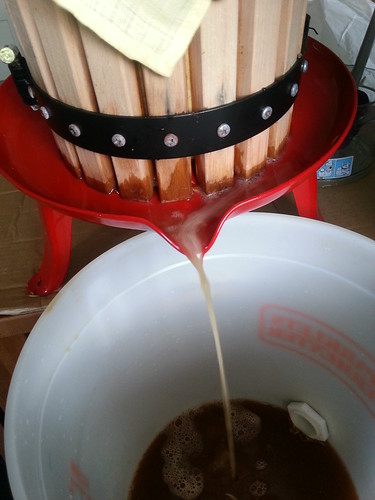
From my last post I have pressed all my apples using a friends cider press and it has femermented into an almost drinkable brew. It is now bottled and maturing. The last bottle I tried was better than the first so in time I could have a decent cider. The recipe was an easy one to follow: loads of apples, pressed then left to ferment, I kept it as simple as that. No yeast, sugar or water added, just apple juice. Again, I have lots more photos so will probably do a longer post for the cider making.

Home Made Cider


Lastly I will add details of my upcoming fund raising event with the hope I can get a few more sponsors. This August will mark the 3 year anniversary of my mother passing away and also approx 10 years from when I last had a full hair cut. In 2004 I had my head shaved for cancer research and raised an impressive £400. This time I'm aiming much higher and am attempting to raise £1000, however I will need a lot of help to do it. I am raising money for the Stroke Association this time, as that is what my Mum died of. Hopefully with your help we can reduce the number of people and families that have to suffer because of this condition. Any little helps, seriously, if you can just manage a pound or a dollar then that is fine. If you are in a position to donate then I ask that you share my donation link via your social media sites and hopefully I will raise a bit more. Here is the link to donate and if you live in the UK then you can donate via text, put this into the body of your text changing the amount to how much you want to donate "IMHS69 £5" and then send to 70070. Thanks greatly in advance for your kindness.

Sunday, 23 June 2013

I'm Back!

After quite a long hiatus I have returned to the blogging world. It's not like I haven't had anything to blog about, on the contrary, I have had lots to write about but due to the time lapsed I think it would be better to bring you up to date with a summary. First off I will give an explanation to my lapse in writing. There were a few factors but firstly was ill health which I will say little of other than our toilet roll expenditure went up somewhat for a period. Then when all was settling down in the bowel department I was hit hard with the loss of a close friend. Along with me loosing my Bees and 3 out of our 5 chickens dying in quick succession I have just not felt like writing. Now I feel like enough time has passed and the amount I need to blog about has built up so I have lots to catch up on.

Anyway onto the summary. I have started a few new batches of wine, 2 made with dandelion, 1 with rhubarb and then a week or two later I made another batch with rhubarb. The dandelion wines are slightly different from one another as I have used red grape juice in one and white grape juice in the other. The recipe is here in the comments section of a previous post. I will write it up eventually and add it to the recipe page (eventually being the operative word). The batches of rhubarb wine are both the same recipe, the only difference is the size of the batch, the first is only 1 gallon but the second batch is 5 gallons! Keeping on the theme of wine I have also bottled 2 gallons of elderberry wine and started drinking it. I'm sure it'll taste better when it has aged more but at the moment it is drinkable and the further down the bottle I got the easier it was to drink although I had a headache at the end!

The land my Dad recently acquired is coming on nicely with more than a little help from my brother in law Lee, although in truth my Dad has done more work than should be expected of a 65 year old! He is a Yorkshire man though so a bit of hard graft doesn't scare him. I have mucked in as much as I've been able to, but due to there being no toilet down there I had a long period where I didn't dare go down there! Between us we have moved loads of clay and exposed the workable land beneath, then covered it in manure in preparation for next year. There is still loads to do down there and now the weather has improved it has got a bit overgrown in a lot of areas but we are working on it a bit at a time and large areas are covered with old carpets for the time being to keep the weeds down. All the trees that were moved down there are coming along nicely but won't produce much fruit this year. This is of little concern, the main thing is that they have plenty of leaves and are putting out new growth. With any luck next year will be a bumper crop!

I never got round to writing up about the last Wakefield and Pontefract Beekeepers Association meeting and now can't remember enough to do it justice. The main subject was on the Warre hive which is a form of top bar hive that involves making tall stack of boxes. One of the big differences with the style of Beekeeping is that rather than adding boxes to the top for the Bees to store honey in you add boxes underneath and the Bees move their brood rearing area down and start storing honey above; this has the advantage that it means the brood is always built on new comb. I may do a more detailed blog about the Warre hive at some point but as my knowledge on the subject is limited I may wait until I know more.

To finish off I will just mention one small last thing....... I have bought a new colony of Bees!!!! Ok, so it is more than a small thing, rather large to be honest and as this post has reached a fair length I will write a separate post for the new Bees!

Friday, 1 February 2013

Wakefield and Pontefract Beekeepers: January Meeting

This Monday just gone was the first meeting we had of 2013 and the guest speaker was a guy called Gerry Collins. I think this was the 3rd time we have had him as a guest speaker and, as one of the times before, his talk was on swarming which included various methods of prevention including the Demaree method. I will be trying this method out on my Bees in the near future so won't go into any details here. If you are interested you can either google Demaree or try this link to Barnsley Beekeepers site that explains it very well.

The talk was fascinating and also very long; the usual meeting are scheduled to finish at 21.00, they were still talking at 21.45 when I had to leave to go to work as I was on the night shift. There was a short break in the middle where I got talking to people as usual and also in this time I picked up something I had ordered from a fellow Beekeeper who had organised a bulk order with Paynes Bee Farm. The item I'd ordered was a poly nuc which is basically a nucleus hive made, surprisingly, of polystyrene; not the kind of polystyrene you get goods packed in but a much denser type that is a lot more resilient and weighs more. Below are the photos of it.


poly nuc hive
The poly nuc

poly nuc hive
This screws onto the entrance giving you option of open, closed with or without ventilation and with mouse guard included

poly nuc hive
It came with 2 plastic inserts that you put next to the hive body and the feeder compartment. This one is a Queen excluder.

poly nuc hive
The hive from above showing the feeder area and the screened bottom.

poly nuc hive
The other plastic insert completely blocks off the feeder.

poly nuc hive
In this photo you can see the light reflecting from the clear cover, with this you can look into the hive with the lid off without disturbing the brood chamber too much.

All in all it looks and feels like a quality product. I can't say anything about the operating of it yet but will be able to later in the season but I am very hopeful that it will help me. Also everyone I talked to has said how good they are for creating nuc colonies. Next time you see this hive it should have a happy colony of Bees in it!

Thursday, 13 December 2012

Wakefield and Pontefract Beekeepers: Novembers Meeting

The last Monday of November was the last meeting we will have of the year as we don't have meetings in December. The meetings main part was a presentation by our association's president who is also the regional Bee inspector for the North East of England. The subject was about giving your bees the best start possible to start the new year. 

We were asked when the beekeeping season really started or was it more dynamic than simply having a start and end date. Does the bee season run from spring to spring, winter to winter or even from when the Queen starts laying to when she finishes laying. 

We also discussed winter mite treatments which include oxalic acid. This treatment is applied when the Queen had stopped laying and there is no brood present. It involves putting small amounts of diluted acid mixed in sugar syrup directly on the bees. This will kill the mites but not affect the bees. The treatment comes either in crystal form or in a pre made solution. This year I have bought a pre made solution as this will be easier for me. 

The presentation also included various graphs showing how quickly the mite population can increase if not treated. It showed the difference between starting the season with only a few mites compared with about 50 and over 100. With only a few it takes a really long time for the mite population to get to really dangerous levels but with 100 mites it takes much less time. Even with 50 it takes a lot less time than with over 100.

Another thing we were shown was a map of our region showing where the different foul brood diseases have been detected over the last few years. Luckily there were no major outbreaks of either disease near to my apiary, though I will still have to be very vigilant for they can be devastating and you have to report any signs of either disease. 

The meetings was finished as usual with a raffle, though as I'd forgot my wallet that was out of the question! I did get offered a cup of tea by a fella that lives close to me, we have since swapped details so the meetings in the new year we will be able to car share. 

Sunday, 4 November 2012

Wakefield and Pontefract Beekeepers: October Meeting - AGM

This Monday just gone was the WPBKA October meeting and also the AGM (annual general meeting). This meeting is more about the running of the association and less about the actual Beekeeping although it did include the yearly report from the regional Bee inspector. I can't remember all that was said in the report but the point was that this year has been the worst year for Beekeeping in living history with honey yields at a record low. My personnel yield being about 5 pounds of honey from 1 of my 2 hives, or an average of 2.5 pounds per hive, which is pretty diabolical!

There were a lot of statistics about the financial side of the association along with how the website is going. The committee members were all voted in again without change, except for the secretary who stood down this year and a new one was voted in. The last part of the meeting was a little more interesting; it was where the various awards were given out. Most of the awards went to familiar faces, there seems to be 3 or 4 people who always do well and a couple of people that do really well but the best part for me was when they called my name out to receive a trophy for winning the Novice class at the Emley Show! I believe my face may have gone a little red when called up as I wasn't expecting an award! Even better still was when the cup was being handed to me the presenter said that even though my entry was in the novice class it could have held up in the other classes! Something to think of for next year.

After the presentation of all the awards we stopped for a tea break and I got talking to a few people, mainly people congratulating me! One guy I was talking to (the same guy I bought the huge sack of sugar from last month) had one most of the awards again this year and I jokingly said to watch out as I now have the taste for winning awards and he seemed very positive about me entering more next year. He even said that if at any point I wanted any advice he would be glad to share all he knows with me, which is great to know seeing as though he wins so many awards. He always wins the mead classes so I asked him what kind of yeast he uses and I was surprised to hear that he uses regular bakers yeast like I have been using for my mead! The rest of the meeting was taken up with the raffle, I was not so lucky this month and didn't win anything.

BeeKeeping Honey Award
First time I've seen my name engraved on a trophy!

Thursday, 25 October 2012

Wakefield and Pontefract Beekeepers: September Meeting

The time of year has come again when my local association hold their Winter meetings. Although as I write this it is near to the October meeting, I am only just writing about Septembers! I seem to have less time to write lately and I'm putting this down to my daughter; she has an in built sensor that detects when I get the laptop out and then just wants to climb all over me thus making writing rather tricky!

This months meeting was a little bit different to any I have attended before in that rather than there being just 1 speaker, the room was set out with multiple tables, each with a microscope set up. The purpose of the meeting was to get a look at microscopy. The first table I sat down at was all about pollen and looking at how different plants produce different pollens. We also looked at a few different parts of the Bees anatomy such as the mandible mouth parts.

The next table was all about looking at the contents of the Bees guts to see if any diseases are present. The main disease we were looking for was nosema. The first thing that was needed to be done to check the Bees gut was to mash the Bees up using a pestle and mortar and then add a small amount of water. A sample of the liquid is then studied under the microscope; I believe they were 900x magnification. The presence of nosema can be identified as small rice grain shaped cells within the liquid. Each sample that we looked at had nosema present  but only in small amounts.


After we had spent about an hour looking through the microscopes we did the raffle. The last thing for me to do was to pick up something that I had ordered from one of the members, which was a 25kg sack of sugar. This is a huge amount of sugar however in Beekeeping and home brewing a lot of sugar is used and this was at a bargain price!


SUGAR!

Sunday, 27 May 2012

WPBKA – Apiary Visit (Saturday 19.05.12)


Once again, this is the beekeepers wife speaking. Apparently I must have done a good job of the last post I wrote, as I have been invited to write another one!

I accompanied the beekeeper to the Wakefield and Pontefract Beekeeping Association Apiary meeting at one of the members’ homes last weekend. The Beekeeper attended this meeting last summer and you can read about this here.

When everyone had arrived at the house we all suited up and began the long adventurous walk to the apiary, through the large garden, orchard and along a public footpath and through some trees. And as anyone who lives in the north of England will know its been raining a lot in the past few weeks so the ground was a bit wet underfoot and some areas were a little muddy. The day itself was dry, but it was dull and very cold, not what you’d expect in May, and more importantly not the ideal weather for inspecting bees as all of the flying bees who would normally be out foraging were at home so the hive was very busy inside.

The Regional Bee Inspector was leading the meeting and he was combining this visit with one of his inspections so was making notes about what he saw in the hives. He was looking at the health of the bees and for signs of disease and also at their strength, which can be seen in how many frames of stores and frames of brood, and if there’s pollen present etc.

The first hive that was inspected was a British National Hive which had a very strong colony of bees in it, and so had 2 brood boxes; which were full of bees. This could have been a problem as when a hive gets too full the bees often swarm. This hive had already had a nucleus of bees removed from it, and it was still very strong, so it was decided that the best course of action would be to split the hive, in a move similar to the one that we describe here.

Whilst we were looking in this hive, a gentleman was showing us how to see the semen in a drone bee. I’m not entirely sure why he decided to show us this, but it was an interesting process involving killing the bee by squashing him, which then made his phallus pop out and the semen was just there. This process can be used to collect semen to artificially inseminate a Queen bee and is called either full or partial “eversion”. This is explained in much more detail in this website.

This illustration comes from the same website and shows the back end of the bee and his endophallus and its horns or cornua.


The second hive that was inspected was a very weak colony in a Dartington Long Deep Hive. There were hardly any bees in this hive and they were showing signs of a disease called Sacbrood.

Although it is not a good condition for Bees to have, Sacbrood is not a notifiable disease and is a relatively common virus that does not usually mean the loss of a whole colony. Sacbrood affects both the larvae of worker and drones but not adult bees. Dead brood is often seen in amongst healthy brood and in a strong colony the adult bees will remove the dead larvae. The dead larvae have a dark, scaly appearance and are sometimes known as “Chinese Slippers” due to their shape.

Sacbrood can be spread in a number of ways including:

  • Beekeepers using contaminated equipment in different hives.
  • Nurse Bees who carry the virus around the hive.
  • Robbing Bees who will attack a weak colony and transfer the virus between different apiaries.
  • Swarming Bees who will carry the virus to their new brood.

Sacbrood is discussed in much more detail – with a picture of it on this website.

There were a number of courses of action that could be taken to help this colony, including killing the old Queen, and adding a new one, a process aptly called “Re-Queening”. There was also a chemical treatment discussed and the option of moving the bees to a different hive that was smaller and much better suited to this size of colony. Unfortunately most of the people at the meeting were all seasoned Beekeepers, the discussion got much too technical for me at this point, so I’ll leave it at that. I did however get the impression that lots of the people there were not fans of this hive design. Its frames are a different size which makes it difficult to swap frames or split the hive unless you have others like it. It is possible though to split the hive using a dummy board, making two completely separate colonies in the one unit.

And finally a nucleus hive was inspected; this was very brief as a number of people were saying they were in desperate need of a warm cup of tea by this point.

We all walked back to the house and had sandwiches, cake and other snacks which were very welcome and very tasty. And perhaps the best bit of the day – we won a bottle of Wells Waggledance Ale in the raffle.

Friday, 30 March 2012

Wakefield and Pontefract Beekeepers: March Meeting

This Monday just gone was the last of Wakefield and Pontefract Beekeepers Association  winter meetings and was titled Apis Through The Looking Glass. We were shown a in depth presentation with slides of honey bees through a high powered microscope. The guy holding the meeting was called Graham and he has a book available at amazon.co.uk also called Apis Through The Looking Glass, which contains the photos featured in the presentation. The presentation was very detailed so I will just go over the basics and what I can remember.

Bees are insects so are made up of three sections; the head, the thorax and the abdomen. On their head they have two antennae, five eyes, a set of mandibles and a proboscis. Their heads are also mostly covered in hairs, including the two main compound eyes (yes, bees have hairy eyes!!). The thorax has the two sets of wings and six legs. The abdomen contains the bees honey stomach along with other internal organs and the sting. In the presentation these were all shown in very close up photos. I have included Wikipedia links for various parts for if you want to read more.

Head


  • The antennae of bees contain many senses which the bees use to detect vibrations, smells and temperature among other things. It is made up of several sections but the male drone has one more segment, believed to be used to help locate Queens on their mating flight.
  • Bees have two kinds of eyes; the compound eye and the ocelli. The two compound eyes are made up of  hundreds of segments which gives them a pixelated view of the world, the male drones have much larger eyes that almost wrap all the way around their head, again they are for helping to locate Queens. The three ocelli are situated on the top of the head and are arranged in a triangle, they are thought to be used to help the bee stay upright and straight when flying.
  • The mandibles are the mouth parts of the bee and are used to chew up the wax scales and build comb. 
  • The proboscis is the bees tongue and is used to suck up nectar from flowers. 

Thorax

  • The larger of the sets of bees wings don't actually physically attach to the muscles that drive them. There are two muscles in the thorax that drive the wings by stretching and contracting the thorax vertically and horizontally, this in turn causes the thorax to push the wing making them beat. The smaller wing has got hooks that connect it to the larger wing when in flight so the aforementioned method that drives the large wing also drives the small one in turn. 
  • The bees legs have two other functions, other than the ability to walk! The first is located on the front legs and is a small nook in the inner elbow that is used to clean the antennae; it works by wrapping around the antennae so they can be scrapped clean prior to flying. The other main function is the  pollen basket; this a hairy area of the back leg that collects pollen, the bee does this by first covering itself in pollen and then brushes the pollen towards its back legs. Then with the aid of a small amount of nectar the bee squeezes the collected pollen through it's "knees" into the pollen basket.

Abdomen

  • The honey stomach is located just in the abdomen, prior to the main stomach and is where nectar or honey is stored when travelling from one place to another. It is similar to the crop in birds. It has the ability to stretch to fill a larger area of the abdomen so in summer months when there is plenty of nectar it will usually be bigger than in the winter when there is no new nectar coming into the hive. When a bee returns to the hive it brings the nectar back up and passes it to other bees in the hive for them to in turn take it to be stored as honey.
  • The rectum is in the abdomen and has similarities to the honey stomach but in reverse. In the winter months, when it is too cold to leave the hive, the bee can store excrement in it's rectum stretching it to occupy most of the abdomen. In the summer the bee is outside a lot more and able to deposit it's droppings outside on a much more regular basis so there isn't as much need for a large rectum. 
  • The sting is located at the end of the abdomen and is the part most people are aware of when in close proximity to bees! Bees have a venom sack connected to the sting that is pulled out of the honey bee when it stings you, killing the bee in the process. The venom only develops after a few days so a newly hatched bee is very unlikely to sting you and has less chance of it causing any damage. The sting of a bee is made of two main rods with barbed ends that move back and forth in opposite directions, thus causing them to dig deeper and administer more venom.


There were other parts included in the presentation including the reproductive system but I don't remember enough to do it any justice if I was to try to write it up. In the future I may learn more and also have access to pictures to show the various parts in greater detail and if so I will do a more detailed post.

Tuesday, 28 February 2012

Wakefield and Pontefract Beekeepers: February Meeting

Monday just gone was the February meeting for my local Beekeeping association. This month the talk was held by a guy from the NBU or the National Bee Unit. The main purpose of the talk was to give the results of some research that has been going on recently. He covered how they conduct their research, which was done over 2 years in random apiaries. There were plenty of pie charts and diagrams to show the different levels of disease that where found within the apiaries. I won't include any of the figures, this is mainly due to not having access to them! The general idea I got was that EFB and AFB aren't at high levels, but other diseases are higher. One of the higher level diseases was DWV (deformed wing virus) and there was a further graph to show how levels of this problem relate directly to varroa levels. All in all the presentation gave me confidence that no matter how many problems the Bees face there is still a lot of research going on to try to combat them.

Within the presentation a lot of emphasis was on encouraging people to register on Beebase Website. I have already done this some time ago and can confirm that it is a very good resource for UK Beekeepers to use. Within the site there is a section for putting details about each hive inspection and can also easily be set up for various different apiaries. There is also a lot of information about the various problems Bees suffer from and what to do. There are lots of .pdf documents to download and print out to hand out to people to provide further info. All in all it's well worth registering if your either a Beekeeper or interested in becoming one.

After the presentation I went to see the secretary as some goodies that I had ordered as part of my associations bulk buy scheme had arrived:-

Apiguard. This is a treatment for varroa mites. There is enough for 5 hives in this box. I'll describe how it's used closer the time that I use. I think it's very similar to the other treatment I used last year, APILIFE VAR, but in an easier to use package!

Another varroa treatment. It's the same as the stuff I used in the winter time except already made into a liquid.

Hessian sacking. This is just a bundle of hessian. It's useful in the smoker and really helps get your smoking working properly.
There are more items that I ordered but they will be there next month. I think all I have left to arrive are some more packs of wax foundation.

Thursday, 2 February 2012

Wakefield and Pontefract Beekeepers: January Meeting

The first meeting of the new year was held by a doctor from Halifax, a town about a half hour drive west of where I live. The subject of the meeting was to give a better idea of the relationship between Bee products (including stings) and health, also dispelling a few myths about honey.

The start of his presentation was a video, I think it was set somewhere in India, showing someone who holds a surgery where the treatment is Bee stings; patients will come to him with different ailments and the "doctor" would administer the stings. In the video there was a claim that 80% of patients felt benefits from the treatment. The guy holding the presentation was, like me, a little sceptical of the claims, however it could have been the placebo effect that was making the patients feel relief. I will not be trying this form of pain relief!

From there the presentation went into allergic reactions to Bee stings and what can be done to lessen the effect. There was a fair bit of medical terminology used that I don't remember but the basics were that the more you get stung the more of a resistance you can build up but on the other hand you can have a severe reaction and develop hypersensitivity at any time. To better prepare yourself for your inspection a single anti histamine tablet was recommended; this taken prior to the inspection will help if you are stung but won't totally stop the effects, especially if you are hypersensitive. If you have a known allergy then maybe it's worth seeing your GP and enquiring about an epipen so if you have a severe reaction you can have something you can administer while waiting for an ambulance. As with all forms of medication you should consult your doctor prior to using them anyway.

This was followed with another video, this time of the survivalist Bear Grylls. Below is the youtube video. I think it speaks for itself!


After we had finished laughing at Bear Grylls expense the presentation went into dispelling a few so called facts about honey and it's healing properties. He did state that people would probably disagree with what he was about to say but he was basing his views on scientific experiment, or the lack of.
I think one of the big ones was that local honey has no proven benefit to people suffering from hay fever; as the pollen is ingested and destroyed in the process there is no real benefit gained from it. He said that no scientific experiment of any credit has shown any reduction in symptoms from using honey. He did however say that in just believing that it'll work may give you benefit from the placebo effect.

There was mention of other anecdotes that show how good honey is for various things but with little scientific proof but one product has been tested scientifically and shown to have the properties that it say it has but not as fully expected! This product is the manuka honey; there is proof that it has above normal antibacterial properties but not if it is ingested. The main use for this honey would be to apply to the skin where you are healing from a wound or similar. Eating it had no extra benefit and apparently doesn't taste very good anyway.

To round his presentation off he mentioned propolis, wax, royal jelly and even Bee larva, all of which are used with no real scientific proof of having medical properties. I think something that has to be taken into account is that his views are based on the lack of scientific evidence to prove the medical benefits, there is also very little evidence to disprove any of this! Basically you can believe it or not and if you do believe it works then there is a good chance you'll notice a difference so why not try it!

There was a lot covered in his presentation and I don't think I have done it justice, however I think I have covered the subject in enough detail for today, if anyone has any further questions please ask me and I'll try to answer them.

As per usual there was a raffle after the presentation but I didn't win anything. It is a good place to go to and discuss how your hives are doing and other topics that interest me. One guy who I talk to regularly has mentioned he has an apple press and would be willing to lend me it if my dads allotment produces a large amount of apples again this year, so home made cider may be on the cards later in the year!

Sunday, 4 December 2011

Wakefield and Pontefract Beekeepers: November Meeting

This months meeting was titled Queens and Things and was presented by a guy called Gerry Collins. As you can probably imagine by the title the subject was Queens and included other little bits.
We did have a presentation by him last year. Gerry mentioned that he used to be a biology teacher and some of this was shown in his presentation; he named a few of the pheromones that Bees produce along with the names of the glands that produce them, unfortunately I don't remember the names or I would have included them here. I may in the future need to learn them when taking advanced Beekeeping exams but at this stage I don't think I need to know them.

We were shown many slides throughout the presentation showing pictures of Queens illustrating the possible problems with locating her majesty. For example in one picture she could be clearly seen and then in a second shot taken seconds after the Queen had disappeared into a cluster of Bees. Other pictures included a Queen that was partly into a cell laying a egg making her hard to see and also virgin Queens that are only slightly larger than workers.

We were also advised about looking for the signs of having a laying Queen. One photo showed a group of cells with more than one egg in each cell. This normally would indicate the possibility that there are laying workers in there (which is bad because workers only lay drones). However in that slide what we were seeing was a young Queen that hadn't learned to just lay a single egg per cell; a clue to this is that although there were multiple eggs, they were mostly central right at the bottom of the cell, when you have laying workers the eggs are generally closer to the sides due to workers having much shorter abdomens.

There were plenty of other things covered but I either can't remember them enough to write up or I have previously written about the subject anyway so have chosen to leave them out. After the presentation there was, as always, a raffle with prizes including a bottle of wine, chocolates and honey storage buckets, along with other bits. I didn't win anything this month although I really would have liked to get some storage buckets, I only currently have 2 and one contains whats left of my honey and the other contains some honey my dad acquired for me over a year ago. The honey my dad got me has set solid in the bucket and it's this that I'm using to make my mead, when I have more mead making experience I will use honey from my own Bees, or what I like to call "The good stuff"

Tuesday, 8 November 2011

Wakefield and Pontefract Beekeepers: Annual General Meeting

The last monday in October was the annual general meeting for WPBKA. This meeting was a members only meeting and involved voting in the associations president, chairman, secretary etc. As far as I could tell all posts stayed the same as last year. Who knows, when I've got more experience I may run for a position, not yet though! 

We had a presentation about finances going over expenses and incomes of the association. I'm no accountant but the numbers seemed ok to me. One area that interested me was the talk about the website being updated soon and after the main part of the meeting I got talking to the guy who runs the website; he had asked us to email him with any ideas for the site and I have also offered to send some photos for the gallery, which I will do in this next week. There was also talk about a facebook page and I offered assistance with that if needed.

Towards the end of the meeting there was a award presentation where trophies were presented to members who have won various prizes for their honey, mead, wax and honey cakes. To finish off there were several certificates handed out for those who had completed parts of the BBKA exams for beekeeping. I hope on the future I will be able to show off some awards or certificates!

I will also mention that I have bought a raffle ticket at the meeting with the first prize being a full hive, complete with Bees, and second being a nucleus hive, also with Bees. The raffle is for a excellent cause, which is Macmillan Cancer Support, in memory of John Dews; John was a highly respected and talented Beekeeper that unfortunately died earlier in the year. I never met him but have heard that he was one of the most knowledgeable Beekeepers in the area.

Tuesday, 27 September 2011

Wakefield and Pontefract Beekeepers: September Meeting

The time of year has come round again when my Beekeeping organization start holding their winter meetings. They are held every month from September through to March, excluding December, on the last monday of the month. This months meeting was held by Dave Shannon with the subject being "Preparing honey & wax for showing”

I set off to the meeting at just after 7 pm and arrived with about 5 minutes to spare before the meeting started. In this time I got talking to a few people who attended the same course as me and am pleased to say that they all seem to be making good progress. One of the guys who lives near me has upped his amount of hives and now has five. One of the others is still on just the one like me and has managed to extract a similar amount of honey as me. I also managed to have a quick word with the guy who ran the course and he seemed happy with everyones progress.

Once inside I got sat down and waited for the presentation to begin. As mentioned earlier todays was about presenting your products of the hive in shows. We were shown several different jars of honey giving an example of light, medium, dark, set and heather honey. Light and medium looked very similar, the difference being the colour; the medium was every so slightly darker. The dark honey was very dark, so much so that it was almost black; we were told that he didn't know what plant this honey had come from and has only managed to get it that dark once in ten years. The set honey was almost the opposite of the dark honey in that it was almost white; set honey is generally made from oil seed rape in this area and grows in abundance near my apiary. To get set honey you extract it as normal and then leave it to go rock solid in the bucket and once it's set hard you then mix it up making it spreadable. This seemed like hard work if done by hand but I've read somewhere that a lot of people consider this one of the best honeys. The heather honey was last to be described; heather honey isn't runny or set, it's gelatinous. The color was a deep red and it contained tiny air bubbles.

There it's quite a lot of criteria a judge loooks for when giving awards out for honey. One important element is to make sure the honey is processed to a high standard. It was recommended to use a heating cabinet to get the honey to about 35-37°C. At this temperature the honey will pass through your filters easier, with the finer filters being better. Once filtered and bottled all the air bubbles had to be given time to rise to the surface (apart from with heather honey) so the honey is clear and free from any imperfections. A tip that was given for removing any further debris that rose to the top of the jars was to use a clean tea spoon and roll it over the surface gently and this should capture any debris at the top. Other tips included making sure your jars are clean, lids are clean, wear a hairnet and do all your preparation plenty of time prior to the show. Another important thing to keep in mind is to carefully read the schedule as important information could be included. 

While talking about presenting honey a few pieces of equipment were recommended. The first was a refractometer; this is a small device that is used to measure the amount of water content in your honey. I think it was 17-19% water content for normal honey and about 25% for heather honey. This level of water is essential to stop the honey fermenting and going bad and honey that is not within this range should never be sold. I have since ordered myself  one for about £18, I'm calling it a early Christmas present for myself. The one I've ordered can also be used to measure the alcohol level so will be useful in my home brewing. Another recommended piece of kit was a smith cuter/scraper. This tool is used to cut the comb with honey in from the frame leaving just the foundation behind. This is useful for heather honey as you can't use normal extraction techniques with it being gelatinous. Once all the comb has been removed from the frames it can then be put in a press to squeeze the honey out, leaving you with plenty of wax. The final tool recommended was a simple LED torch which is used you look through your jars of honey and will help you to spot imperfections in the honey.

After talking about honey he moved onto wax for show. Again some points were the same, emphasizing cleanliness. Also the schedule is important to read for wax as it will give info on the weight of the wax cake your showing. The type of wax used for show is generally what is collected from cappings as this is the lightest coloured and most presentable. It will take me a long time before I have enough wax cappings to make a block for show! A tip given for showing wax was to make sure the mold is fairly hot before pouring the wax in so it all cools at the same time and makes the wax consistent all the way through.

When the talk on showing wax was finished there was a refreshment break and at this point I had to leave as I was working the night shift that night and it was already approaching time for me to set off.

Friday, 16 September 2011

Apiary visit 16/09/2011

Last week I put treatment in my hive to combat the rising level of varroa mites. As it's a 4 week course of treatment yesterday was the time to put in the second stage. During the week I have been reading about the treatment I am using, which is APILIFE VAR, and have read a few shock stories about it. The problems people have reported include Queens dying, Bees absconding and very aggressive behavior. Due to this I have been very worried through the week and dreading what I was going to see when I got to the apiary. Also there has been some awful weather this last week including very strong winds and heavy rainfall.

Luckily when I went to the allotment yesterday the weather was perfect; the sun was shining, the sky was clear and there was nothing more than a gentle breeze. The allotment had lots of people taking advantage of the good weather including the guy in the allotment next to the one I keep the Bees. After saying hello to the guy I suited up and got into the apiary. This time I didn't even light the smoker as I was only planning on being in the hive a short time. In the apiary I was really pleased to see Bees coming and going, with quite a few with full pollen baskets. 

Upon opening the hive the first place I looked was in the supers; I was amazed to see how much honey the Bees have collected seeing as though I collected the liquid gold a couple of weeks ago. As mentioned in an earlier post all honey collected will be left for the Bees to help them get through the winter. When checking through the super frames I was expecting to see eggs laid by the Queen, due to there being nothing to stop the Queen getting into the supers, but there weren't any. After the quick look through the super I moved to the brood chamber. The treatment bars I'd put in last week were still present in the back corners but the pieces added to the front corners of the hive had vanished, I assume the Bees dragged them out. At this stage the Bees seemed to be getting slightly agitated so I hurried in getting the old treatment out and the new one in. After that I quickly put the hive back together and exited the apiary.

When I was clear of the apiary I got talking to the guy in the next allotment. He told me his son has recently got some Bees in the York area. His son's Bees are apparently a lot more aggressive than my Bees and has been advised he shouldn't have been sold them in the first place as a beginner. His Bees generally follow him all the way back to his house, which is at least 60 foot away by what I was described; my Bees follow me about 10 foot then go back to the hive. The place I was talking to the guy was only 15 foot from my hive and I had already taken my suit off while talking to him and had no Bees bothering me. I just hope they stay that way as if they get aggressive I would have no option but to remove them from the allotment and at the moment have no where else to put them. 

I will also mention while I am writing this post that Wakefield and Pontefract Beekeepers held an event at Newmillerdam last weekend which me, Steph and the baby went to on the Sunday. It was held in the small boat house and had a few tables with information, example hive, an observation hive and a table for honey sampling. As it was such a small area we only stopped a short amount of time but managed to taste some honey that was flavoured with stem ginger. Both me and Steph agreed this honey was delicious and would at some point attempt to make some. There was the guy that ran the training course there but I didn't manage to talk to him as it was so cramped in there and he was talking to someone who was interested in becoming a Beekeeper. 


Sunday, 4 September 2011

Apiary inspection 30/08/2011 and Honey Extraction!!!

Last Tuesday I went up to the apiary to remove the honey that my Bees have kindly made for me. I didn't want to take too much from them as they have worked so hard for it so I took 5 completely capped frames and left all the half full ones. The Bees will continue to collect honey up until the flowers have gone but what they collect from now will all be theirs and hopefully this will reduce the amount of sugar syrup I'll need to feed them over the winter.

This time I was on my own and didn't take any pictures and will be taking less pictures in the future as I don't want too much repetition. When I arrived the first thing I did was light the smoker and then suit up. When I was suited up I went to the hive and removed one of the supers and swapped around the frames so I had 5 full frames of honey and 5 frames the Bees haven't got round to drawing out yet. The weight of the frames were impressive and later on worked out to be over a kilogram each. When I'd got the frames of honey I closed the hive up and collected the debris underneath to do a Varroa count later. I didn't inspect the brood chamber this time as the hive had been open a while by then.

When I got home I sent an email to the secretary of Wakefield Beekeepers asking for the contact to hire an extractor for the day. I was sent details of a man called Keith that lives a couple of junctions up the motorway so was in short driving distance. I called him on Thursday and arranged to pick the extractor up after work. The extractor is a 9 frame electric one and it cost £2 to rent for the day, bargain.

The frames in the super

A almost fully capped super frame

Using a sharp knife the cappings are removed

A sticky job but fun


The frames are placed in the extractor which spins at high speed forcing the honey out of the frames

The liquid gold running into a storage bucket via a pair of tights! This filters out bits of wax in the honey. I will need a better filter if I intend to sell the honey

The first jar of my honey
I took the above bottle to work to let people taste it and I think it went down well.


You may have noticed that there has been no mention of the varroa count up until this point. I haven't forgot, I just didn't have time to do it until today. There were 71 mites that I counted which was over 15 days. Below is the report from Beebase. I will be treating them ready for winter on my next inspection even though the count is still low as it's increasing at a alarming rate.

Average Daily Mite Fall = 4.7 varroa mites
Estimated number of adult varroa mites in the colony = 190
Treatment is recommended in about 9 month(s) time (counting from day of first monitoring).


Friday, 26 August 2011

Apiary inspection 15/08/2011

I've finally managed to get caught up with my blog posting with this post. 10 days ago me and Steph did an inspection, however this time she was really brave and did most of it. In fact the only things I did were light the smoker, open the hive, remove the first frame and any heavy lifting. She enjoyed it so much that she has agreed that a hive in our back garden is a strong possibility but is likely to be a top bar hive; a top bar hive would mean less heavy lifting and looks a lot nicer than just a wooden box not to mention a top bar hive will be cheaper!

Steph all suited up

The smoker ready to go

If you look almost in the centre there is a Bee emerging from it's cell!


Steph looking very professionally 

Queen Bee-atrix and plenty of brood

This is the frame nearest the entrance, I think they put the holes there for extra ventilation


Beekeepers together!

I also took the debris from the varroa board and later that day counted the mites. I found 37 mites and that was over 14 days. Using the calculator on the Beebase website I got the following result:

Average Daily Mite Fall = 2.6 varroa mites
Estimated number of adult varroa mites in the colony = 110
Treatment is recommended in about 9 month(s) time (counting from day of first monitoring).

Although the results are again fairly low I intend to treat the hive as soon as I've removed the honey, which hopefully will be next Monday or Tuesday. I will then contact my local Beekeeping club who offer a extractor for hire. With any luck I should have some honey in the next few weeks.


Tuesday, 26 July 2011

Apiary inspection 26/07/2011

Over the last couple of weeks I got an email from Wakefield and Pontefract Beekeepers telling me that there was a potential new Beekeeper in the village I live in. They passed me his contact details and today we arranged to meet up so I could show him my Bees. He had already been to see another apiary in the village, but the other apiary had several more hives than mine, I believe he said around 15 hives all together!

At around 3PM I met up with him and we headed up to the apiary together. Upon arrival we suited up and lit the smoker then headed into the apiary. The first job I did was remove the varroa board and scrape the contents into a box so I could do a varroa count later on. After that I handed the camera over to him and asked if he would take photos as I went. 

First I took the roof off


Next I removed the super and put it to one side exposing the Queen excluder

Then the Queen excluder was removed, making sure the Queen wasn't on the underside

I then removed the plastic dummy board
The first frame with capped stores

The capped cells in this one are worker brood


Queen Beeatrix with her entourage 

Me and a Bee inspecting a frame


Holding the hive tool so it's at hand when needed

I tried to remove as much of the excess comb on the top of the frames


A frame from the supers


Capped honey stores

Looking into a super


After we had checked all the frames in both the supers and the brood chamber I added another super so there are now 2 supers on the hive; this gives the Bees plenty more room to store honey as there is a good honey flow on at the moment.

When I had dropped my visitor off I returned home and poured the contents from the varroa floor onto a sheet of white paper and counted the mites on there. I counted 14 mites and then using the calculator on the Beebase website I got the following information:
Average Daily Mite Fall = 2.0 varroa mites
Estimated number of adult varroa mites in the colony = 80
Treatment is recommended in about 2 month(s) time (counting from day of first monitoring).

Varroa mites